Golgotha
Golgotha / Calvary
 Golgotha, also called "Calvary," is where
Jesus was crucified. While the
Holy
Sepulchre Church claims Golgotha is a
rock inside its compound, the Bible says Golgotha is a "place,"
not a rock.
Golgotha, also called "Calvary," is where
Jesus was crucified. While the
Holy
Sepulchre Church claims Golgotha is a
rock inside its compound, the Bible says Golgotha is a "place,"
not a rock.
The Bible also says "where Jesus was crucified was near the city" (John 19:20). As discussed, since the Holy Sepulchre Church is inside Jerusalem, not "near" the city, it cannot be the location of Golgotha.
Then where is Golgotha / Calvary?
 The location is given by the
name "Golgotha,"
which all three gospels in the Bible that mention it identify as the
place of
"a Skull" or "the Skull":
The location is given by the
name "Golgotha,"
which all three gospels in the Bible that mention it identify as the
place of
"a Skull" or "the Skull":
"And when they had come to a place called Golgotha, that is to say, Place of a Skull" (Matthew 27:33). "And they brought Him to the place Golgotha, which is translated, Place of a Skull" (Mark 15:22). "And He, bearing His cross, went out to a place called the Place of a Skull, which is called in Hebrew, Golgotha" (John 19:17).
Why is it called the "Place of a Skull"?
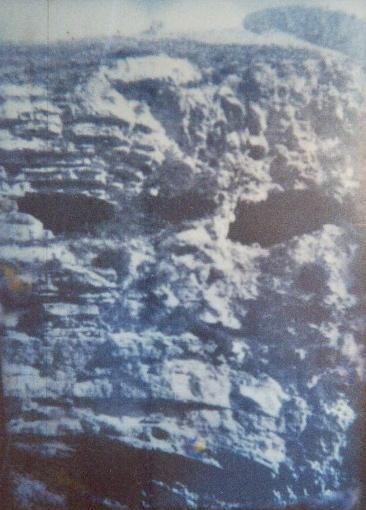
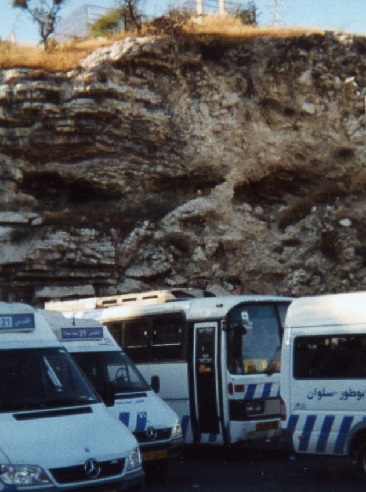
"Golgotha" was and is the name of a cliff face whose rock protrusions and indentations made it look like a human skull (top). "A Skull" (or "the Skull") in the verses quoted above are the English translations of the Greek word κρανίου (craniou), from which the English word "cranium" is derived. All three gospels recorded κρανίου in its singular form, not plural, to indicate that Golgotha isn't the place of many skulls as Holy Sepulchre Church claims, but the place of "the" or "a" - single - "Skull."
Where is Golgotha?
Golgotha / Calvary is located just outside Damascus Gate and faces the major east-west road that runs just north of Old Jerusalem. It is precisely the type of location where the Romans liked to crucify rebels so that their gruesome handiwork can scare the passing masses and deter future rebels against Rome.
This means Jesus was crucified with the skull-faced cliff in the background - i.e., His cross was at the bottom of this cliff, at ground level, not on top of it. As explained above, the Romans crucified people on major roads, not on hard-to-reach hilltops, because they wanted the passersby to see the victims' gory end up close, not from afar. Besides, access to the top of this cliff is difficult from Old Jerusalem and requires a prohibitively long detour.
Then why is the cross of Jesus always portrayed as being on top of a hill?
That is more picturesque and continues the tradition started by Roman Catholic art. The Bible, however, never says that Jesus was crucified on a hill.
The top photo is of a photo taken in the late 19th century and found on a pole facing the cliff. Westerners began to trickle back into Jerusalem in the 19th century. Among them were Christians whose eyes narrowed when they saw the skull-faced cliff above.
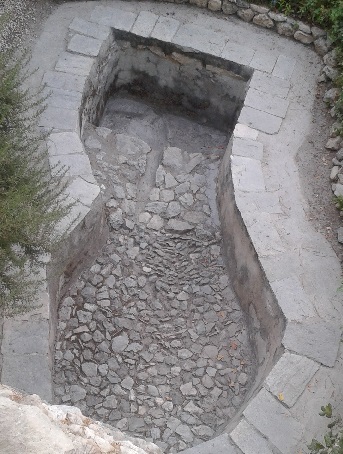 Excavations inevitably began in its vicinity and soon enough, they
unearthed a first century wine press, now restored (photo) and an
underground water cavern, both evidences of a garden having been present
during the time of Jesus (first century gardens served an economic purpose). And at the other end of this garden, 90 meters from the skull-faced
cliff, they found a first century
tomb that had been cut into a rock,
exactly as described in the Bible.
Excavations inevitably began in its vicinity and soon enough, they
unearthed a first century wine press, now restored (photo) and an
underground water cavern, both evidences of a garden having been present
during the time of Jesus (first century gardens served an economic purpose). And at the other end of this garden, 90 meters from the skull-faced
cliff, they found a first century
tomb that had been cut into a rock,
exactly as described in the Bible.
The second photo above is of Golgotha as it appears today. The skull's nose has eroded and the mouth lies below the asphalt cover of a bus station that was built in 1953 and resurfaced twice since then, but the eye sockets are still visible. Jack hammering prior to each resurfacing eroded and vibrations from the passing traffic continue to erode the face of the cliff, so the eye sockets may not last long.
Why is the place where Jesus was crucified the back wall of a bus station today?
Christians lack political power in Israel, but still, this is appalling. The place where Jesus was crucified should be preserved and at least kept quiet like Jesus' tomb so that people can take a quiet moment to ponder why He was crucified.